









The speed of light is a vexing plot impediment for any SF author who wants their characters to zip off to another star system and come back without finding a much-transformed world when they return home. No surprise that this bold assertion on The Association for Space Propulsion Development site caught my eye.
These experimental data (VERIFIED SEVERAL TIMES) demonstrate that the thrust of a PNN propulsion spaceship can be incredibly increased OVER TIME with the same power used, inevitably exceeding the speed of light.
This courageous proposal raises many questions, such as why nobody has ever suggested circumventing the light-speed barrier simply by going very, very fast. After all, the only impediments are some trifling engineering details, which the ASPD is working on, and the laws of physics.
In fact, people have proposed this before. Take these five examples.
“Space Rats of the CCC” by Harry Harrison (1974)

The focus of Harrison’s story is the process by which candidates are transformed from raw recruits into stalwarts of the Cosmic Camel Corps—or more often, into dismembered corpses. Nevertheless, the means by which faster-than-light travel was attained is explained so clearly I will eschew my usual chronological approach to place the Harrison first:
When the inventor, Patsy Kelly, was asked how ships could move at seven times the speed of light when the limiting velocity of matter, according to Einstein, was the speed of light, he responded in his droll Goidelic way, with a shrug, “Well—sure and I guess Einstein was wrong.”
To be fair, if we noticed phenomena that could not fit into the standard model, some new model would be required. The obvious historical examples are the matter of Mercury’s precession and the invariance of the speed of light, both of which presented seemingly insurmountable challenges to Newtonian physics. That doesn’t seem to be quite how Kelly managed the trick, though.
The Skylark of Space by E.E. “Doc” Smith (1928)
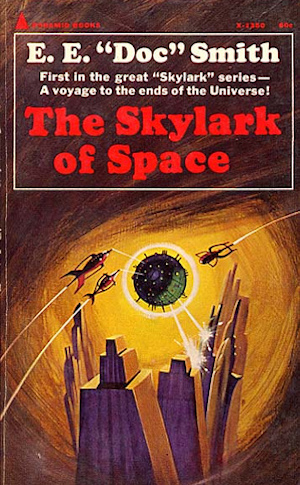
Focused as it is on super-science, industrial espionage, kidnapping, and breakneck adventure in deepest space, Skylark does not have room for a detailed explanation as to how the speed of light could be exceeded. In fact, there’s no explanation at all, only the observation that it has been.
“Three hundred and fifty million miles. Halfway out of the solar system. That means a constant acceleration of about one light.”
“Nothing can go that fast, Mart. E equals M C squared.”
“Einstein’s Theory is still a theory. This distance is an observed fact.”
“And theories are modified to fit facts. Hokay.”
It’s hard to argue with observation, although it is a bit of pity that there’s no room to detail what model should supersede Einstein’s.
I am inexplicably reminded of Edgar Rice Burrough’s riposte concerning certain inconsistencies between Mars as astronomers thought it to be and ERB’s Barsoom, that the scientists only had remote observation to go on, while ERB’s John Carter had actually been to Mars.
Islands in Space: The Challenge of the Planetoids by Dandridge M. Cole & Donald W. Cox (1964)
Although this non-fiction text focuses primarily on asteroids, and the case for exploring and exploiting them, as well as suggestions as to how this might be done, in Chapter 17 (“By Planetoid to the Stars”), the authors do touch briefly on that whole thing with the light-speed barrier, about which the authors appear quite skeptical. Maybe the consistent results from decades of experiments are misleading!
If relativity has been found to be correct in all these cases, then it would seem that it must really be a universal law of nature. But again, we call on P.W. Bridgman—“Experience is determined only by experience. This practically means that we must give up the demand that all nature be embraced in any formula, either simple or complicated.”
And now we note a certain basic similarity in all the tests of the relativity theory. They all involve objects, particles, or radiation, moving at high speed with respect to an accelerating, decelerating, or otherwise perturbing, external electromagnetic, or gravitational field. We come now to the significant point that the high-speed rocket is not accelerated by an external field! The mechanism of rocket acceleration is fundamentally different in character from any of the phenomena which have been used to check relativity! We cannot assume that the simple formula which holds in one natural realm will hold in this fundamentally new domain.
However, as they point out, relativity is only an issue for people who want to make round trips. Your Nearly as Fast as Light voyageur need never concern themselves with the phenomenon, provided they never return.
While some may find Cole and Cox’s case against Einstein somewhat short of compelling, I do recommend the text. Readers will find there, in their original form, many of the proposals for space development to be found in more recent space advocacy books.
Citizen of the Galaxy by Robert A. Heinlein (1957)
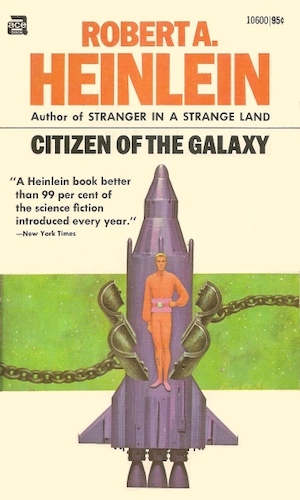
Whereas Heinlein dabbled in relativity in his 1956 Time for the Stars, his ambitions for Citizen—which is a spy novel, a Norton-style Free Trader novel, a barracks drama, and a boardroom drama all in one—left no room for Einsteinian flourishes. Instead, Citizen’s starships exceed the speed of light through the simple expedient of brute force and purely Newtonian acceleration1:
But a ship which speeds up by a kilometer per second each second will take three and one half standard days to reach speed of light.
Exactly why Einstein’s model does not apply is left to the reader’s imagination, as is how exactly one accelerates a starship at a kilometer per second cheaply enough (or at all) for interstellar trade to be reasonable. The plot requires that this be possible, so it is.
Heinlein fans may be interested to know that Citizen is slated for an animated adaptation under director Jay Oliva, with a script by Luke Lieberman.
Orbitsville by Bob Shaw (1975)
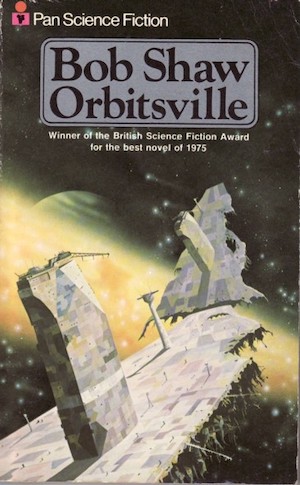
Vance Garamond’s life would actually be better if the flickerwing starships Vance pilots were relativistic, as that would allow him to use the Lorentz-Fitzgerald contraction to escape space oligarch Elizabeth Lindstrom’s wrath for having inadvertently allowed Linstrom’s child to fall to his death. As it is, Vance can only flee through space, not time, and there is nowhere in space where Lindstrom’s influence will not eventually reach.
And why does Einstein not apply?
(W)hen a body of appreciable mass and gravitic field reached speeds approaching .2c it entered new frames of reference. Once a ship crossed the threshold velocity it created its own portable universe in which different rules applied, and it appeared that the great universal constant was not the speed of light.
I suspect that “appreciable” is a load-bearing term in that exposition.
The go very very fast approach to superluminal flight is so obvious, the examples above are only a very small sample. Why, I didn’t even mention Beckman’s classic Einstein Plus Two! Undoubtedly, I may have overlooked your favourite examples. Extol their virtues in comments below.
- Heinlein had dabbled in relativity-skepticism before, in Farmer in the Sky.
“Mr. Ortega, admitting that you can’t pass the speed of light, what would happen if the Star Rover got up close to the speed of light—and then the Captain suddenly stepped the drive up to about six g and held it there?”
“Why, it would—No, let’s put it this way—” He broke off and grinned; it made him look real young.
“See here, kid, don’t ask me questions like that. I’m an engineer with hairy ears, not a mathematical physicist.” He looked thoughtful and added, “Truthfully, I don’t know what would happen, but I would sure give a pretty to find out. Maybe we would find out what the square root of minus one looks like—from the inside.” ↩︎

You could also add the vast majority of science fiction television shows of the 20th century, including Space: 1999, where the Moon somehow manages to drift between multiple star systems in the span of just a few years of story time (more than the two years it ran for, but not that much more), and Battlestar Galactica (the original), where the ragtag fugitive fleet could achieve a maximum of lightspeed yet somehow traversed multiple galaxies in the course of a season. (Although in its universe, galaxies were somehow directly adjacent, so that crossing into a new galaxy entailed no interruption in the starfield, like crossing a state line.)
ISTR an official BSG comic that at least implied that the refugee fleet could go FTL but that a lot of the ships could not sustain it without constant repair. This resulted in a movement pattern of intermittent FTLsprints combined with stretches of moving STL and hoping they weren’t noticed.
The idea in the show was that Galactica and the fastest ships could reach lightspeed, but many of the other ships were slower. I think a lot of less science-savvy writers are unclear on the distinction between travel at the speed of light and travel faster than same. I’ve seen things that used “lightspeed” synonymously with FTL.
I thought it was fairly obvious that they were using “lightspeed” loosely & colloquially to mean FTL.
In some shows, yes, but Galactica said that only the fastest ships in the fleet were capable of reaching lightspeed, which means that a fleet of mostly sublight ships still managed to traverse multiple galaxies within one season.
Ah, Space: 1999. Such admirable production values, spacecraft design and special effects, such a craptastic grasp of physics; I believe it was Damon Knight who described it as “The most highly polished and beautifully mounted coprolite ever seen.”
It should be noted that in the novelization of the original Battlestar Galactica pilot movie, there a was scene where the Galactica makes an emergency hyper-space jump. I think it likely that detail got dropped out of the shooting script due to fear that it was too similar to the Millenium Falcon’s jump to lightspeed.
To be fair, the first season of Space: 1999 wasn’t trying to be plausible, but in its clumsy way was embracing kind of a surreal, Twilight Zone-ish cosmic-horror angle, portraying outer space as an unknowable realm where all our certainties about existence fall apart and the characters are hopelessly out of their depth, just struggling to survive the inexplicable. It actually works kind of well if you approach it as surrealism rather than sci-fi. (The second season was just dumb, though.)
Presumably BSG was expressing the fairly common confusion between “star system” and “galaxy”, and all the action takes place in just one of what is actually a galaxy. Admittedly this doesn’t answer the question of how something limited to lightspeed can travel between star systems.
For those of us into astronomy, it can be astonishing how little comprehension laypeople have of what the word “galaxy” means. I once came across a science fiction-themed art book, one of those things that compiles various paintings and illustrations the artist has done with framing text stringing them together into a loose narrative, in this case presented as the narrator’s journal. There was a point where the narrator said, “We’re two light-years from Earth now. Just a few more galaxies to go.” Ummmmmm….
Isaac Asimov wrote a contemporary mystery story in the 1970s where an intelligent, educated man asks what a galaxy is. He gets a correct description, but I’ve always been a little sceptical that the character wouldn’t know already. I suppose it was literally Asimov’s full-time job to understand what a non-specialist audience knew about science, so maybe he’d know better than me.
It is confusing that there are other galaxies inside the Milky Way, which it is eating. And there’s the classification of star clusters, unless that’s the same thing.
There are satellite galaxies whose orbits take them through the stellar disk. I think there’s maybe one that’s currently inside it.
Technically, the stellar disk we think of as the Milky Way is really just the nucleus of the galaxy, like the pit in a peach. It’s surrounded by a large halo of gas, star clusters, and loose stars, and an even larger halo of dark matter that encompasses over a dozen smaller satellite galaxies including the Magellanic Clouds. In a sense, that entire thing is the actual galaxy.
In my Hub stories from Analog, the titular Hub is a cosmic anomaly at the center of mass of the galaxy’s dark matter halo, through which one can instantaneously travel to or from any point within the halo, including those dozen-plus galaxies. It’s the only method of FTL travel in that universe, so all interstellar (and literally intergalactic) travel has to pass through it, making it a nifty setting for a series.
On this point, it has always irked me that the German intro to ST:TNG had something that tranlates to “Enterprise advances into galaxies that no man has seen before.”.
I was always irked when the one-line description in newspaper TV listings for the film Total Recall, which took place on Earth and Mars, described it as a tale of “intergalactic” intrigue.
Doc Smith would later create a slightly more detailed workaround, of course. In the Lensmen books, they found a way to cancel inertial mass (without just disintegrating), and declared that the lightspeed limit only applied to things bound by inertia, whereas a “free” ship was limited merely by the balance between its thrusters and the drag from interstellar gas and dust. (Never mind that light also has no mass and seems limited to the speed of light. I never said it was a GOOD workaround.)
In Samuel R. Delany’s NOVA, people row spaceships from one star system to another in a matter of hours or days. Delany gives an explanation, but I can’t remember any of the details. It might be similar to the LENSMAN explanation, which I’ve always adored for its brazenness and scientific-sounding language (emphasis on the “sounding” part).
The Justice League did it back in the day…
DC comics back in the Silver Age pretty much ignored relativity to death. There were many characters, notably the Supers, J’onn J’onzz, and the Flash, who could go as fast as the plot required. This inevitably led to the story called “Race to the End of the Universe!” in which Superman and the Flash did exactly that (well, sorta), and — equally inevitably — ended in an ambiguous ending where who won depended on the camera angle you were looking from or some such fudging, because they could admit neither that “the Fastest Man Alive” wasn’t, nor that anybody could beat Superman at anything. (These days, I believe, though I’ve not been much of a comics reader for 30 years, the Flash is unambiguously faster due to some mystical thingmabob called the Speed Force … whatevs.)
Relativity isn’t the only thing. It’s bugged me ever since high school that the Flash can run faster than 8 km/s, Earth’s orbital velocity, without his feet leaving the ground. At that speed, Earth’s surface would be curving away from his feet as fast as gravity could pull him toward it, so he should cease to have any friction against the ground and be unable to run any further. And if he ran above 11 km/s, escape velocity, he’d fly right off into space.
In the Silver/Bronze Age, the answer to any such question was “because of the Flash’s unique aura”. Since the 90s it’s been “the Speed Force”. Either way you slice it, superpowers pretty much inevitably part course with physics well below the Flash’s power level.
I think it would be more interesting if the Flash (or some other speedster) had a firm 8 km/s maximum speed. It’s good for superpowers to have limits. You don’t want to make things too easy for your heroes.
You should read W. Dow Rieder’s Doc Future stories, where Flicker is a speedster where this and many other issues are addressed.
Heinlein had some very similar-sounding relativity-disbelief in Time for the Stars, which is even more odd inside an entire novel based around the so-called “twin paradox”. There the skepticism gets cut off with one line of correction: but I think it’s very notable that the skepticism is expressed at length in direct dialogue, and the correction is one line not of dialogue but of reported speech. (I don’t have the book handy, or I’d quote it.)
And the quoted conversation in Farmer in the Sky takes place on a ship powered by a mass-energy converter. Heinlein was happy enough to accept that part of the same theory.
Yet another Heinlein work, Starman Jones, relies on wormholes. Throw in the generation ship from Orphans of the Sky and he has most of the approaches covered in one book or another.
In TITS defense, the fact telepathy is “instant” and everyone agrees on the same instant says relativity is incomplete.
Even with my liberal arts bachelor’s degree in physics,
I’m aware that any instant face to face communication between star
systems runs into the problem that “simultaneity” in different places
is _not defined_, because it depends on relative motion.
Since the invention of the telegraph, we’ve gotten so used to more
or less instanteous communication between distant places that we
appear be unable to conceive of its absence. I’ve been rereading the
Foundation series after discovering the TV version. Asimov introduced
the “subspace relay”, and the TV series (and Star Trek) has kept it in,
so that in the TV Foundation we have TV broadcasts and face to face
chats across the galaxy.
And Babylon 5 uses(used?) tachyon relays. – cuz “everyone knows” that tachyons move faster than light speeed (in fact they HAVE to do so).
“Subspace” is a term that’s been around in science fiction since the 1930s for a hypothetical realm allowing FTL travel or communication; like many terms in SF, it may have been coined by Jack Williamson.
https://sfdictionary.com/view/119/subspace
Star Trek: The Original Series used the term only in reference to communications, but later productions established that a ship at warp travels through subspace.
Roddenberry’s vision of Star Trek included the idea that distant
communication could not outpace a ship, hence like Hornblower,
Pike or Kirk would often have to make big decisions without
referring to their central authority. That’s out the window with later
Star Trek, though there always seem to be technical barriers preventing
them from checking with the brass at the key decision points.
Wet-navy ships did have fast specialized ships for communications.
I seem to recall SF instances of specialized ways to get FTL communication
much faster than ships. (In TOS, specifically “The Trouble With Tribbles”,
they got an asynchronous message from Starfleet. I’m not sure when they
introduced the idea of talking back to that message.)
I’m not sure it’s even possible to have FTL without the potential of violating
causality. Though in Star Trek they’ve had time travel since TOS.
Subspace radio could travel faster than a starship, but it had range limits. The intent was that the Enterprise was operating far out on the frontier, months’ travel at least from Federation territory, so that a subspace message could be far faster than a starship but still take weeks to reach home. This is something the modern shows tend to forget — like the nonsensical premise in Strange New Worlds: “The Serene Squall” that it’s unusual for a Starfleet explorer ship to travel outside of Federation territory (where the hell else would an explorer ship be?!!).
TOS was inconsistent about subspace contact with the admiralty — sometimes it could happen in real time, sometimes it took weeks to get a reply. Enterprise patched the continuity hole by establishing the idea of subspace relay beacons that could amplify and accelerate a signal, so that you could have real-time conversations if your ship was in range of a relay, but not otherwise.
As for causality, modern theory says that a time traveler would either be constrained to cause the events of their original timeline (because the travel would quantum-entangle the past with the future they came from, thereby locking it in as the only future they could observe) or would split off a parallel timeline that would coexist with the original. So in neither case can a time traveler alter or undo the events of their own past, and grandfather paradoxes can’t happen. I take that to mean that there really isn’t any causal restriction on FTL travel. Even if it allowed someone to learn about events before they happened, they’d be constrained from doing anything that would alter it. (This is a central issue in my novelette “The Moving Finger Writes,” which is the first story in my new collection Aleyara’s Descent and Other Stories, and can also be found on my Patreon site.
More correctly “sub-ether”. :-)
one of my favorite books in this category is
Man in a Cage by Brian Stableford. Very little detail is given — they just “find out” how to negate inertia.
The rest of the book is about the main character, who is schizophrenic, and his journey to Alpha Centauri. Previous voyagers all went insane, so this time they send someone already in that state.
the middle paragraph above is meant to be a blockquote but doesn’t look like one on my phone.
Wow, an inertialess drive. Nobody has ever promised to sell one before in the history of humanity.
Surely not.
Not even a person called “Dean”.
Le Guin’s Ekumen books have Nearly as Fast as Light starships, and the fact that using them almost always means exiling yourself from everyone you know does come up. In The Left Hand of Darkness, Therem realizes just how lonely that makes their first visitor from another world.
The physics of those ships, and of the instantaneous-mesaging device called an ansible, is always off-screen. We do know that the instantaneous-communication device called an ansible was invented much later. Shevek, the physicist who invented the ansible, was trained is in a different set of physical theories: someone observes that the Terran Einstein’s work might help them resolve some issues about the nature of time.
In an early story (Chastnye predpolozheniya, apparently never translated into English) in Strugatsky brothers’ classic future history “Noon Universe”, the cosmonauts departing for a decades-long relativistic journey catch at a straw in recent discoveries and find that if they keep flying under several gees for several years (both subjective), SOMETHING inverts the relativity and they return to their loved ones after half a year objective.
In the slightly later Noon, 22nd Century itself, this is replaced by outright FTL jumps but with a running start again:
Perhaps you could translate that explanation? :-)
In Jack Campbell’s “The Lost Fleet” universe, I think you can’t enter a jump point if you’re going faster than, um. I think it’s 0.1c maybe. This often requires hard deceleration as you approach. And going faster than maybe 0.2c interferes with radio communication – except with other ships travelling at around the same velocity. And because it’s that kind of series, weapons targeting.
I’ve always kind of admired the way that James Schmitz handled it in Witches of Karres. The ship has drives. The drives make the ship go. Obviously they go faster than light given that they bop between star systems in a matter of days or weeks, but the speed of light barrier is never brought up, much less how they’re beating it. How do the drives work? We’re not told. They’re drives. They make the ship go.
I can’t argue against that, either. None of the characters has any reason to talk about the physics of engines, or how the nova guns watch for movement, or how the ship keeps the air inside fresh. The Captain presumably studied all that years ago, and the witches don’t care. The drives are drives. They make the ship go.
I think I have to dispute the placement of Citizen of The Galaxy on this list. While I don’t have a copy on hand for direct quotes from the text, I have a distinct memory of a conversation between Thorby and a female shipmate in which he tries to explain what happens when the starship Sisu makes an interstellar jump. While the details escape me, it does involve some kind of near-instantaneous traverse through a higher-dimensional realm, which the passengers can’t detect for the simple reason that humans don’t have the sensory equipment to do so, and have to rely on higher mathematics to describe the effects. One can’t accuse Thorby of mansplaining, however, as, rather amusingly, it’s later revealed that despite the young lady in question being much more qualified in trans-dimensional math than he, she was deliberately leading him on due to his status as the captain’s adoptive son, and therefore a tempting target for a socially ambitious girl to target romantically.
“She was letting him mansplain so he could feel clever” does not equal “he was not mansplaining”
If answering direct questions on a subject the other person raised constitutes mansplaining, what doesn’t?
It’s also kind of hard to see Thorby’s alternative: refuse to answer her questions in case she’s feigning ignorance?
(If he weren’t clueless about her intentions or his own interest, he might have asked around about her. But he’s the new kid and has the usual Heinlein juvenile protagonist blind spot re romance.)
“It just works” is a great answer for FTL drives. Rather like the incident where a group of scientists were given a tour of the ST:TNG set to a group of scientists. In the transporter set, their guide pointed to what the scripts call “the Heisenberg compensators,” which supposedly resolve the problem of not being able to observe both a subatomic particle’s location and its speed. One of the scientists asked, “How do they work?” Without any pause came the response: “Very well.” :-)
I can’t recall where I first read it, but one justification offered is an assertion that relativity only prohibits mass from accelerating to the Speed of Light. Actual travel at the Speed of Light or even greater speeds is not technically prohibited— you just can’t accelerate to get there. So a rocket is out… something else, however, might be in. We just don’t know what it could be.
An interesting idea would be the concept that the Universe is basically a big flat sheet (if you will) of energy and data, with the presence of anything in the Universe is simply a factor of the energy of the Universe at that spot being so configured that the thing (even a person) is “produced” by the Universal field at that spot. But if you change the “instructions,” if you will, the Universe could instantly reconfigure so that the thing (or person) for which the data and energy apply is now at a new location, anywhere in the Universe. How one would do this with any form of technology, or if such an instantaneous alteration of the Universe’s quantum code (if you will) could even be done at all, I leave solely to the imagination.
Something with non-zero rest mass traveling at the speed of light has relativistic mass that (at least according to the formulas we have) becomes infinitely large. It therefore then collapses the entire universe into a black hole.
(Calculus classes address the problem of what you get when you multiply zero by infinity. In the case of massless particles traveling at the speed of light, the answer comes out to a finite number.)
Something traveling faster than the speed of light winds up with both mass and time that involve the square root of minus one. It’s not clear what that would even mean.
“Something with non-zero rest mass traveling at the speed of light has relativistic mass that (at least according to the formulas we have) becomes infinitely large. It therefore then collapses the entire universe into a black hole.”
Except that would never actually happen, because it would take an infinite amount of time for an object to reach an infinite relativistic mass. Infinity, by definition, can never actually be reached. It’s a mathematical limit you can move toward but never achieve. As a rule, an infinite value in an equation has no physical meaning and is merely a mathematical abstraction.
In more practical terms, an object accelerating arbitrarily close to c would need a prohibitive amount of energy to get there, and the friction from the interstellar medium would slow it down or burn it up before it got too close to the limit, not to mention that the radiation from ahead of it would be blueshifted into the hard gamma from its POV and probably kill anyone aboard and maybe also burn it up.
“(Calculus classes address the problem of what you get when you multiply zero by infinity. In the case of massless particles traveling at the speed of light, the answer comes out to a finite number.)”
Yup. Put simply, infinity is the reciprocal of zero (or rather, the limit of 1/x as x goes to infinity is zero), so zero times infinity is basically 0/0. And since any number times zero equals zero, that means that zero divided by zero can be any number. Hence, massless particles are constrained to travel at exactly c but can have any quantity of energy.
“Something traveling faster than the speed of light winds up with both mass and time that involve the square root of minus one. It’s not clear what that would even mean.”
Gregory Benford claimed in Timescape that it would mean tachyons would travel backward in time, but I’ve always been skeptical of that, because it would make the time dilation imaginary, not negative. But then, negative time dilation would mean that an outside observer would still see a ship traveling forward, but when it reached its destination, the crew would be younger. Which is different from traveling back to an earlier date as seen by an outside observer, as in the novel. So maybe imaginary time would have that result for a reason a physicist like Benford would know better than I would (as someone who barely managed to graduate with a BS in physics despite never really getting a handle on the calculus). The novel was apparently based on his real-life theoretical study of tachyons.
Although quantum teleportation theorists later came up with the idea of circumventing the Uncertainty Principle by entangling the teleported particle with a reference particle, so that you only have to measure the difference between the positions and momenta of the two. Which works nicely as an answer to how the Heisenberg compensators work, and I’ve posited as much in my Trek novels. I found that quantum error correction also works nicely as an explanation for how someone can be reassembled intact after their transporter pattern has degraded or been interfered with to a significant degree, because it entails duplicating the data so that all the information can be recovered even if portions of the transmission are lost.
The entire Dune saga
I think it’s infinitely improbable to go faster than the speed of light. That’s why I just put my starship at every point in the universe simultaneously and get out at the point I want. Now excuse be, I need to go make a fresh cup of really hot tea….
In my novel Infinity has been stolen, the ships travel at 5 million times the speed of light.
James Blish’s Cities in Flight had an inverse mass/speed thing going on — the bigger you were the faster you could go, so it made sense to fly entire cities around.
At one point, New York builds enough spindizzies to launch a planet, which hurled off between galaxies, where, in the flatness of uncurved space, they learn that Things Are Happening and Someone Needs to Do Something about it.